Australia’s tourism map is being redrawn, and the force behind the change is not only traveller preference but national policy. At the centre is THRIVE 2030, the federal visitor economy strategy, which entered its next action phase in February 2026. The plan targets a $230 billion visitor economy by 2030, with $95 billion explicitly linked to regional tourism promotion. That figure matters because it tells operators, investors, and local councils that visitor dispersal beyond Sydney, Melbourne, and Brisbane is now a funded national priority rather than a marketing slogan.
Austrade as the coordinating engine
Austrade is the operational nerve centre of this agenda. Its 2026–27 corporate plan notes that regional tourism contributes more than 7% of regional jobs, making visitor dispersal a direct economic lever for communities outside the capitals. Austrade’s role goes beyond promotion. It coordinates the Regional Tourism Infrastructure Investment Attraction Strategy, working with pilot regions such as the Snowy Region, Kangaroo Island, and the Katherine Region to channel investment into tourism products that improve access and experience. The logic is simple: infrastructure follows policy, and policy follows national economic interest.
Twelve Apostles as a test case
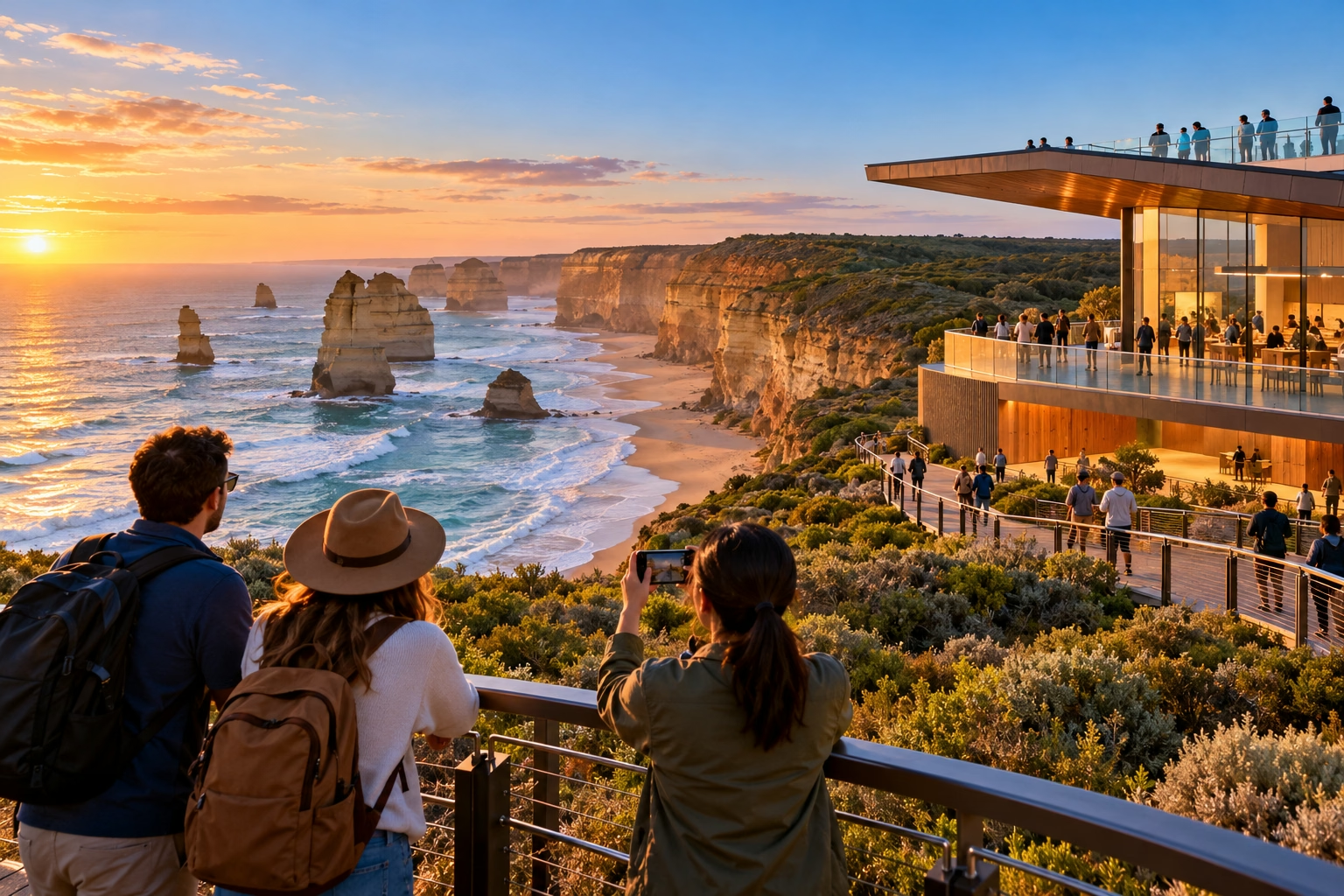
The $126 million redevelopment of the Twelve Apostles precinct on Victoria’s Shipwreck Coast shows how policy becomes practice. Jointly funded through the Geelong City Deal, the new Keerray Woorroong Visitor Centre opened in October 2026 with immersive digital exhibits, regional dining, and a rooftop viewing platform. More importantly, the site introduced a timed-entry booking system designed to spread peak demand and convert brief roadside stops into higher-yield regional experiences. The project created more than 750 jobs during construction, showing that regional tourism investment delivers immediate workforce benefits alongside long-term visitor economy gains.
The dispersal dividend and its tensions
The strategy is producing measurable results. In the year to March 2026, regional NSW welcomed 63.7 million domestic visitors who spent $25.8 billion in the state, while also attracting 712,700 international visitors. Nationally, the international visitor survey recorded 8.43 million trips and $40.47 billion in spending in the year ending June 2026, a 16% increase that regional destinations are increasingly positioned to capture. Yet dispersal also exposes pressure points. Skills shortages in regional hospitality remain a constraint, and the corporate plan acknowledges that workforce challenges must be addressed to build business resilience. The policy blueprint is clear, but its success depends on whether regional communities can absorb and sustain the growth it is designed to generate.