A Shift Driven by More Than Nostalgia
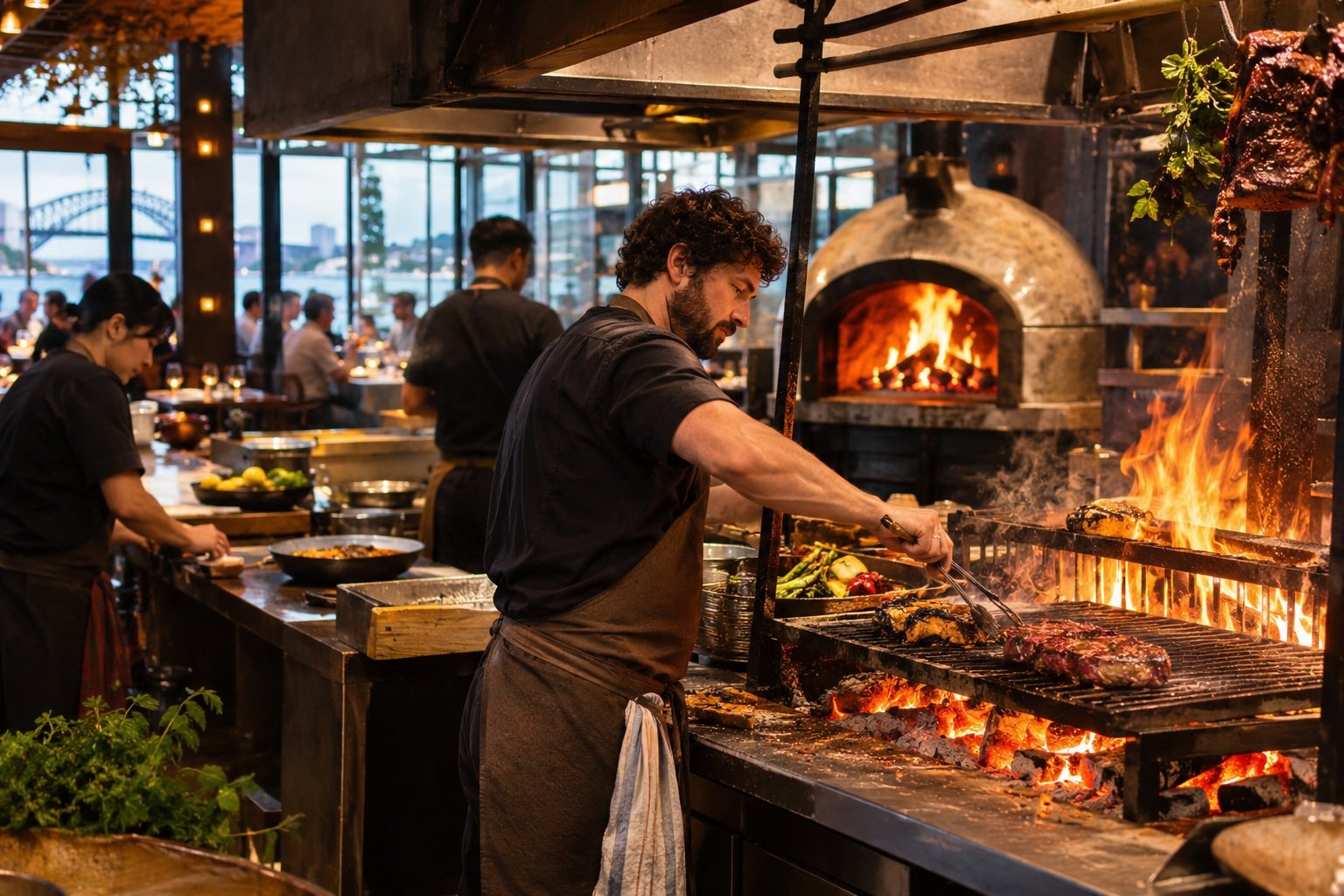
Australia‘s professional kitchens are quietly abandoning the precision of sous-vide circulators for something far less predictable: burning wood. The Staff Canteen’s 2025 industry report identified this as a “micro trend” reshaping how chefs work, noting that “wood grills, hot pans and live-fire ovens are defining features across many new openings,” with chefs actively welcoming “a small degree of unpredictability” back into their cooking. By 2026, that micro trend has become a full-scale movement.
The economic rationale is as compelling as the sensory one. A single wood-fired grill eliminates the need for multiple gas-powered appliances while adding a theatrical element that no induction hob can replicate. Pony Dining’s expansion to Barangaroo in November 2026 illustrates the commercial confidence behind this shift: the new 200-seat venue triples the size of its 20-year-old Rocks site and introduces a dedicated wood-fired oven, multiple grills, and even a wok section—all designed around “the transformative power of natural fire”.
The Venues Leading the Charge
Sydney‘s Firedoor remains the benchmark. Celebrating a decade of 100 percent wood-fired cooking in 2025, chef Lennox Hastie’s Surry Hills restaurant has proven that a kitchen without gas can achieve fine-dining consistency night after night. Further west, Magma by Dany Karam in Canley Vale has built its entire identity around open-flame steakhouse cooking, launching a collaborative “Food + Fire” series in 2026 that pairs Karam with visiting chefs for one-night-only menus built entirely from scratch over the grill.
In Melbourne, the upcoming Agnii in Windsor represents something genuinely new: a Sri Lankan restaurant built around a traditional dara lipa hearth and poranuwa clay oven. Chef Gayan Pieris told Broadsheet that “in a commercial kitchen context, I don‘t think it’s ever been done before,” noting that repeated use of clay pots “builds their own character—we call it adding soul”. The restaurant opened in August 2026, bringing a technique rooted in South Asian domestic kitchens into a 160-seat commercial setting for the first time.
What This Means for the Australian Palate
The return to fire is not merely a chef‘s indulgence. It reflects a broader recalibration of what diners value: visible craft, irreducible texture, and food that tastes of something other than temperature control. As the Australian Good Food Guide observed in its 2026 survey of wood-fired venues, the common thread is “heat, smoke, and culinary craftsmanship” creating dishes that are “both vibrant and soul-warming”. In an era of restaurant homogenisation, fire offers differentiation that cannot be franchised.