
For decades, Australian evenings revolved around free-to-air prime time schedules. In 2026, that ritual has largely dissolved. Streaming services have become the default way millions of Australians consume drama, comedy, documentaries, and reality programming. The shift is not just about technology; it reflects a fundamental change in how audiences expect entertainment to be delivered.
The Decline of Appointment Viewing
Appointment viewing—where households tuned in at a set time to watch a show—has been steadily eroding. According to the Australian Communications and Media Authority (ACMA) in its 2026 Communications and Media Report (https://www.acma.gov.au/), 83 percent of Australian adults now use a subscription video-on-demand service every month, up from 70 percent in 2023. Meanwhile, weekly broadcast television viewing has dropped to 14.2 hours per person, while streaming accounts for 21.5 hours. This crossover, first seen in 2024, has widened significantly.
The report also highlights that younger Australians aged 18–34 spend less than four hours per week on traditional TV, preferring short-form video and on-demand libraries. Even older demographics are migrating, with the 55–64 age group increasing streaming usage by 18 percent year-on-year.
Local Platforms Fight for Relevance
While global giants like Netflix, Disney+, and Amazon Prime Video dominate subscriber counts, Australian-owned platforms are carving out niches. Stan, owned by Nine Entertainment, has invested heavily in local original productions such as Scrublands and Black Snow, while also securing exclusive international deals. Binge, operated by Foxtel Group, leverages its HBO and Warner Bros. Discovery content pipeline, including The Last of Us and House of the Dragon. Binge has also strengthened its position by bundling with Kayo Sports, creating a combined entertainment and live sport offering.
Foxtel’s Hubbl device, launched to aggregate multiple streaming apps into one interface, has had a mixed reception. Industry analysts note that while the hardware simplifies discovery, many consumers still prefer native TV apps. Nevertheless, the battle for the Australian living room has intensified, with free-to-air broadcasters also upgrading their BVOD platforms—ABC iview and SBS On Demand both reported record streaming hours in early 2026.
The Rise of Ad-Supported Tiers
Cost-of-living pressures have accelerated the adoption of cheaper, ad-supported streaming plans. Netflix’s ad tier, introduced in Australia in late 2022, now accounts for approximately 30 percent of new sign-ups in 2026, according to industry estimates. Disney+ and Amazon Prime Video have followed with their own ad-supported options, often priced at half the cost of premium tiers. This hybrid model has opened streaming to lower-income households while creating a new revenue stream for platforms.
For advertisers, the opportunity is significant. Streaming platforms now offer targeted, measurable ad placements that traditional television cannot match. However, consumer tolerance remains fragile; surveys indicate that excessive ad load could push viewers back to ad-free tiers or illegal alternatives.
What This Means for Australian Viewers
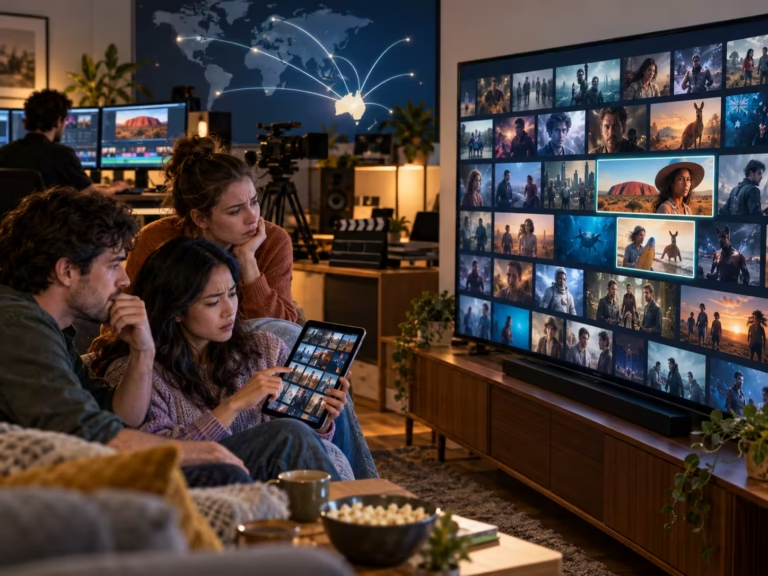
The streaming boom has delivered unprecedented choice, but it has also fragmented audiences. Viewers now juggle multiple subscriptions, navigate different interfaces, and face decision fatigue when selecting what to watch. In response, recommendation algorithms have become central to the user experience, with platforms using viewing history, time of day, and even weather data to surface content.
Australian audiences are also benefiting from a local content renaissance, as global platforms face regulatory pressure to invest in Australian stories. The result is a more diverse, accessible, and on-demand entertainment ecosystem than ever before—one where the remote control’s channel buttons are becoming relics.