The Regulatory Landscape Transforms Overnight
When Australia’s streaming content obligations commenced on 1 January 2026, the nation’s screen sector entered uncharted territory. Under the new framework, streaming services with more than one million Australian subscribers must invest at least 10% of their total program expenditure for Australia—or 7.5% of their revenue—on new local drama, children’s, documentary, arts, and educational programming. The Albanese Labor Government positioned this as a landmark intervention designed to guarantee that Australian stories remain visible regardless of which remote control viewers hold.
The Compliance Loophole That Worries Producers
Yet industry veterans caution that regulatory mandates rarely function as a silver bullet. As Jason Potkins, a policy advisor for the Department of Infrastructure, Transport, Regional Development, Communications, Sport and the Arts, explained at the Australian International Documentary Conference in March 2026, the new regulation permits a three-year acquittal for programme expenditure. Screen Producers Australia CEO Matthew Deaner acknowledged this flexibility could prove destabilising. “They can aggregate it over three years, so they could spend on one programme, three years worth of energy,” he warned, adding that this approach could create significant gaps in commissioning activity across genres.
From Local Production to Global Reach: The Discoverability Problem
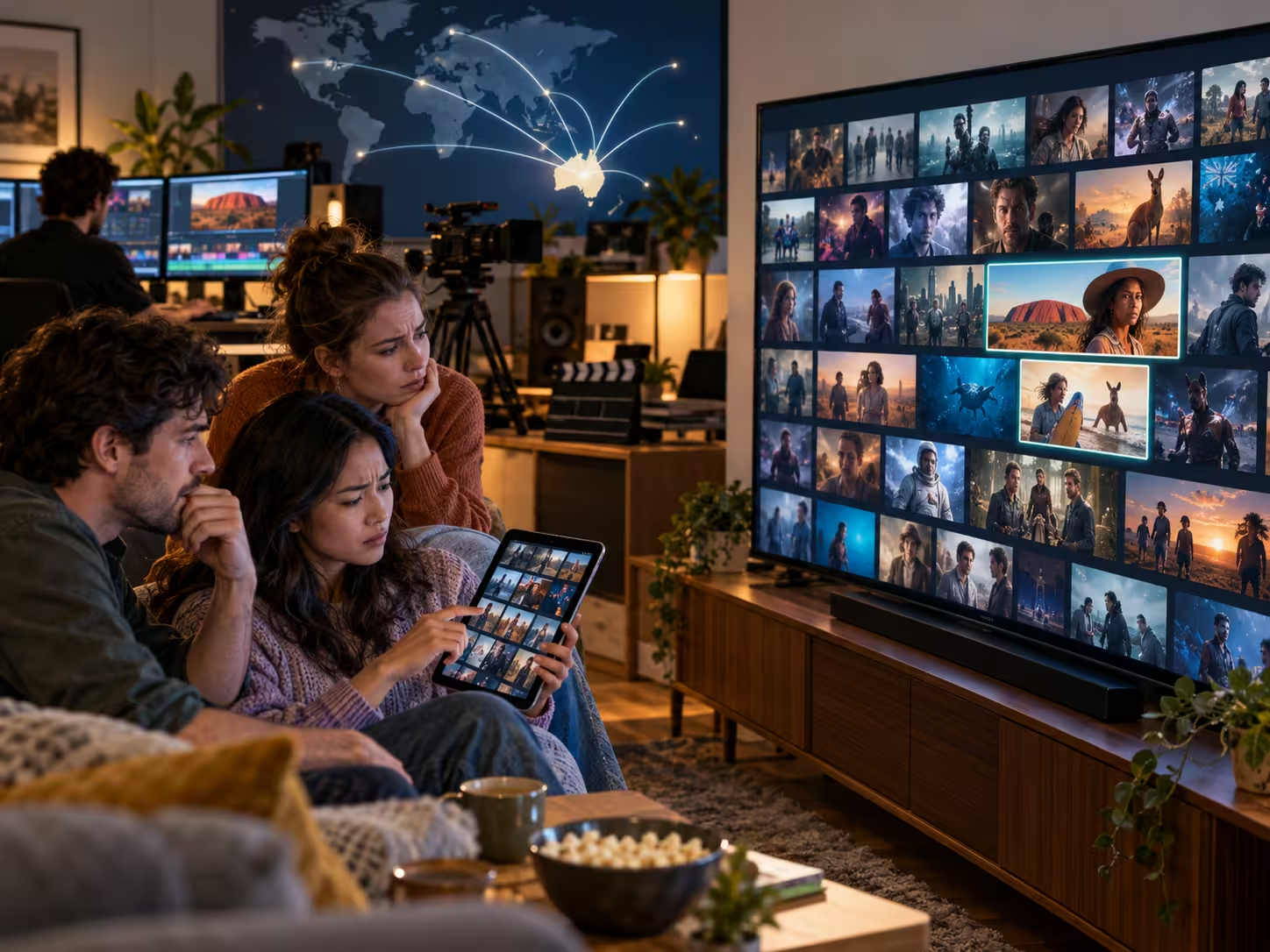
The regulatory intervention arrives at a moment when Australian content’s global potential has never been more evident—nor its domestic discoverability more fragile. Screen Currency 2026, a comprehensive research study commissioned by Screen Australia, reveals a paradox at the heart of the sector. While 84% of Australians agree access to local screen content is important and 75% express interest in watching more, nearly two-thirds of Australians spend less than 30% of their viewing time on it. Only 36% say local content is easy to locate.
Screen Australia CEO Deirdre Brennan framed the challenge bluntly: “Ensuring we reach people is now as important as producing that content. Future success will require support for Australian businesses to build enduring intellectual property, strengthen audience relationships, improve discoverability and compete confidently in global markets”.
The Economic Case for Global Ambition
The stakes extend far beyond cultural preservation. According to the Screen Currency 2026 Global Insights report, Australian screen and games exports totalled $1.6 billion in FY 2023/24, with the games sector alone generating 95% of its revenue overseas. The sector contributes over $11 billion to the national economy and directly employs nearly 70,000 people. These figures underscore that local IP is not merely a cultural asset but a substantial economic engine.
The global appetite for Australian storytelling is demonstrable. Paramount recently sold the Australian medical drama The F Ward to broadcasters and streamers covering 100 international markets, including Channel 4 in the UK, CBC in Canada, and JioHotstar in India. This commercial validation suggests that when Australian IP reaches global platforms, it performs.
What Comes Next for Australian Screen IP
The streaming obligations represent a necessary first step, but they cannot substitute for strategic audience development. Screen Australia has responded by launching three new Market & Audience programs—Assets, Audience Testing, and Channel Management—providing producers with up to $45,000 for asset creation and $15,000 for audience testing. These initiatives acknowledge that production funding alone is insufficient without a corresponding investment in discoverability and global positioning.
The fundamental question for 2026 and beyond is whether mandated investment will catalyse a genuine transformation in how Australian stories travel—or merely satisfy compliance requirements while leaving the deeper structural challenges of global distribution unresolved.