
The Tipping Point: From Niche Fandom to National Phenomenon
Something fundamental shifted in Australia’s entertainment landscape during 2025 and 2026. K-Pop, once confined to dedicated fan communities in major cities, has exploded into a mainstream cultural force that now shapes fashion, dance, food, and even school lunchboxes across the continent. Producer Alice Chang, who organised a K-Pop showcase for Brisbane’s BrisAsia Festival, described the transformation bluntly: “We have a huge and growing community. I love it because it brings the community together, more so than just the music”.
The catalyst? A convergence of global cultural juggernauts. Netflix’s animated film KPop Demon Hunters became the streaming platform’s most-watched title of 2025, and its anthem “Golden” spent an extraordinary ten weeks at number one on the ARIA charts. For Australian dance studio owner Suzi Coronado Veranes, the impact was immediate: “As soon as the Demon Hunters movie came out, the numbers just blew up. Korean fashion, Korean skincare, Korean music is just a big phenomenon at the moment”.
BTS and Stray Kids Anchor Chart Dominance
The musical momentum extends far beyond animated films. BTS’s album ARIRANG debuted at number one on the ARIA Albums Chart in March 2026 and held the top position for a second consecutive week, becoming the group’s fourth chart-topping album in Australia. Meanwhile, Stray Kids—featuring Australian members Bang Chan and Felix—have now landed in the Australian top 20 nine times, with their EP This & That reaching number three.
These chart achievements reflect a deeper structural shift. In 2026, Australians visiting Korea numbered approximately 267,000, the largest figure on record, according to Yoon Sun-min, Director of the Sydney Korean Cultural Center. “Interest is expanding beyond K-food and K-beauty to literature and performances,” Yoon noted, describing Australia’s engagement with Korean culture as a “stage of maturity” rather than a temporary fad.
The Dance Studio Revolution
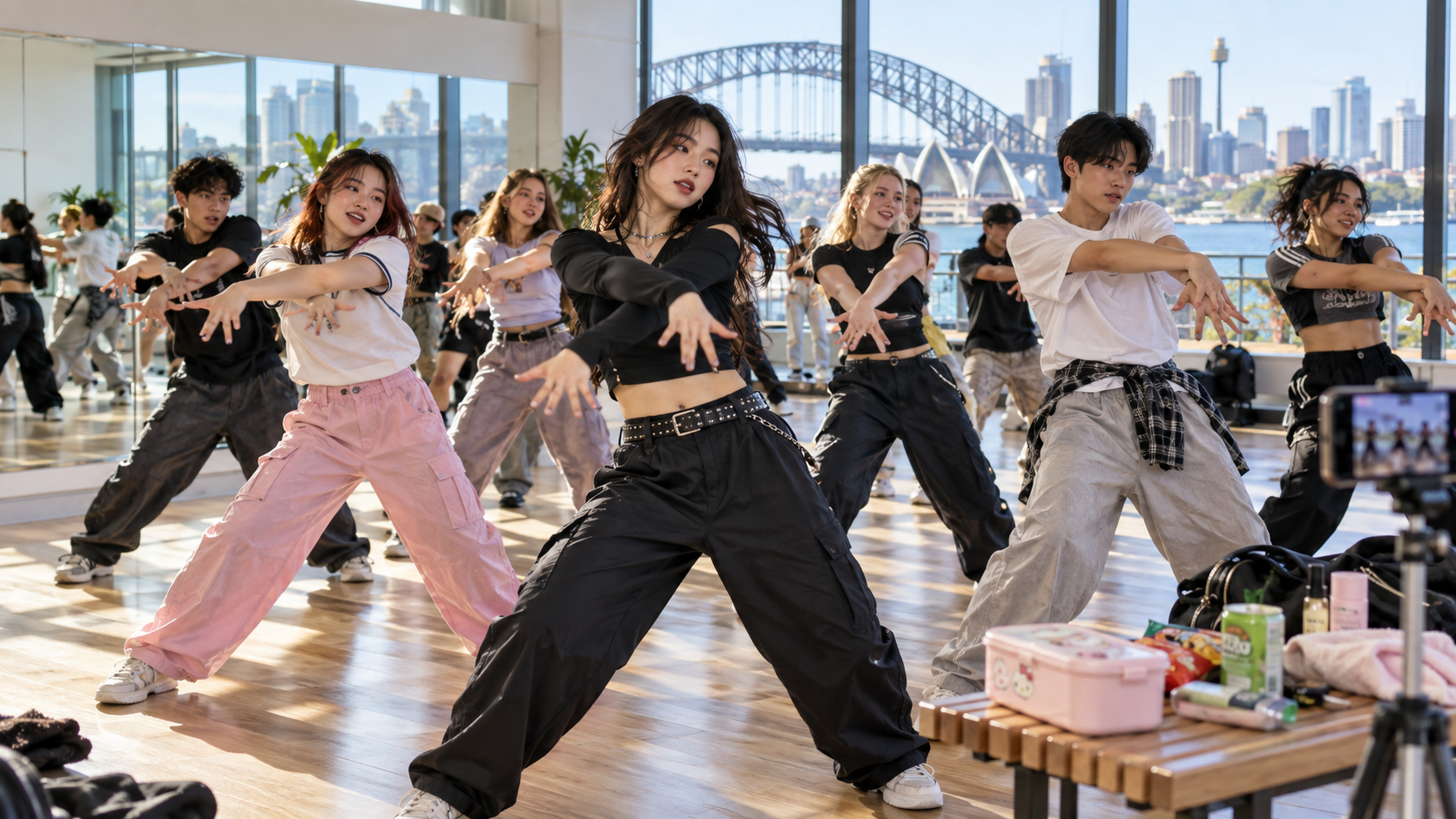
Perhaps the most tangible evidence of K-Pop’s mainstreaming lies in Australia’s dance studio economy. Instructor Raina Joo, who began teaching in Korea two decades ago, now witnesses unprecedented demand in Australia: “It was already popular, but now it’s booming!”. Her students, like thirteen-year-old Vivi Pham Dac, represent a new generation for whom K-Pop is not foreign culture but simply culture. “I am absolutely in love with BTS and Stray Kids. They work so hard. They write their own songs, and sing and dance; they’re so talented,” Pham Dac says.
Longtime performer River Hart, who commutes weekly from the Gold Coast to Brisbane to practice with her group LI7, has watched the community’s evolution firsthand. “It’s been really amazing to see it grow from a very small community to a massive community,” she reflects. “There’s ballad music, there’s rock music, there’s pop music, there’s rap music, and it’s very visual as well. It’s not just the music that people are into. The production that goes behind all of K-pop is incredible”.