The Solar Maximum Advantage
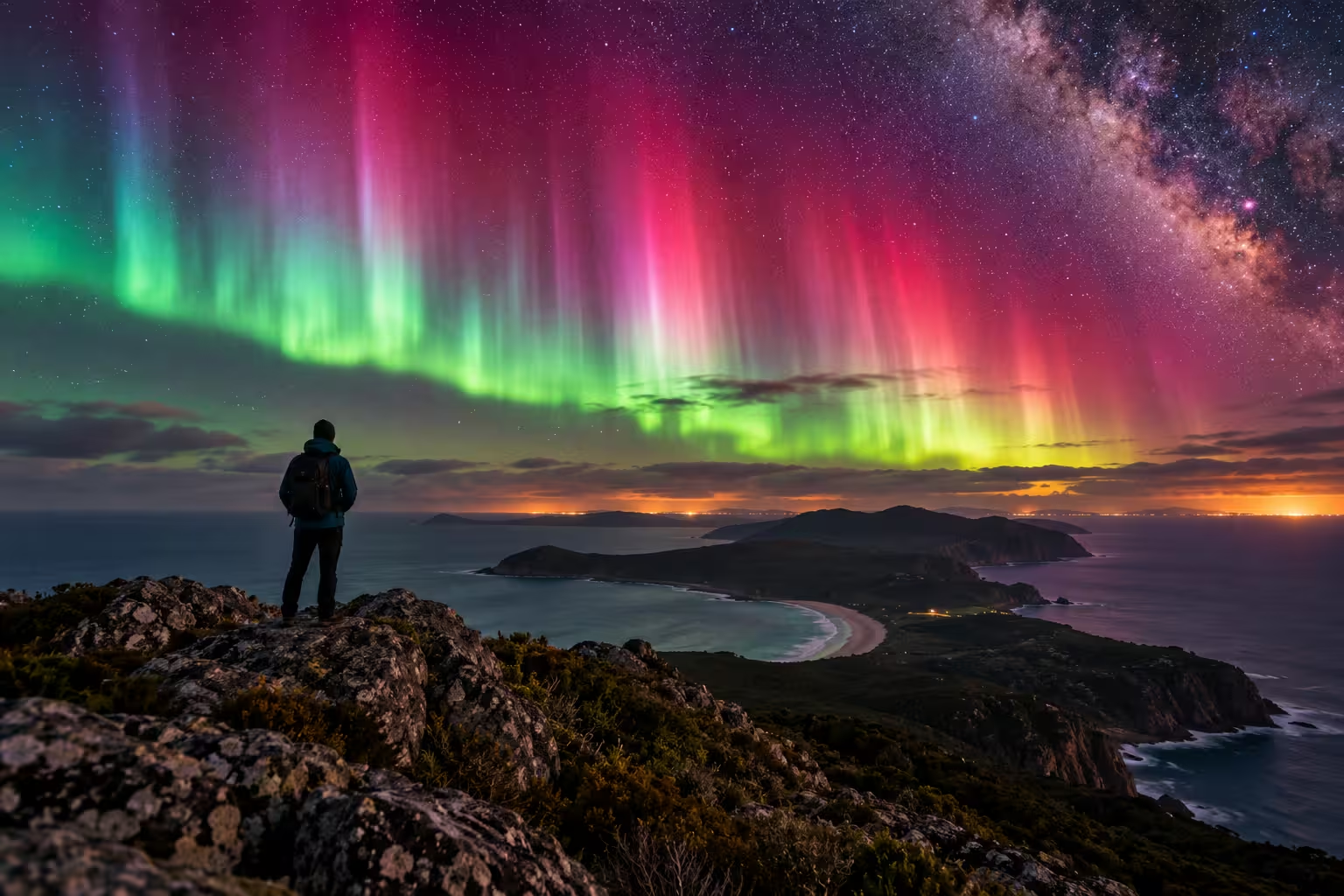
Tasmania has quietly become one of the planet’s most compelling destinations for aurora enthusiasts — and 2026 is arguably the best year in over a decade to witness the southern lights. The sun is currently near the peak of its 11-year activity cycle, a phenomenon known as solar maximum, which dramatically enhances the frequency and intensity of aurora australis displays across the southern hemisphere.
Unlike its northern cousin, the aurora borealis, the southern lights remain far less commercialized. There are no crowded viewing platforms or ticketed viewing areas. Instead, aurora hunting in Tasmania is a raw, weather-dependent pursuit that rewards patience and preparation.
Where to Position Yourself
Daniel Schoedler, a Hobart-based aurora-chasing expedition leader, identifies several prime hotspots along Tasmania’s southern coastline. The summit of Kunanyi (Mount Wellington), Bellerive Beach on Hobart’s eastern shore, and Goat Bluff on the South Arm Peninsula consistently deliver strong sightings when geomagnetic conditions align. On particularly active nights, the southern shores of Bruny Island can offer unobstructed views toward the Antarctic horizon.
The Bureau of Meteorology’s Australian Space Weather Forecasting Centre has identified three distinct windows of heightened aurora activity in 2026: 12–16 July, 10–14 August, and 8–12 September. These periods correspond with coronal mass ejections from the sun that interact with Earth’s magnetosphere, producing the characteristic green, purple, and crimson hues that define auroral displays.
The Technology of Aurora Capture
One of the most significant shifts in aurora tourism has been the democratization of astrophotography. Modern smartphones equipped with night mode can now capture auroral displays that the naked eye might perceive only as a faint grey glow. For those seeking more detailed captures, a digital SLR with a wide aperture lens and long exposure settings remains the gold standard.
The key insight for first-time aurora chasers is that the camera often sees what the eye cannot. A display that appears underwhelming in real time may reveal vivid structure and color when photographed.
Beyond the Aurora
Even on nights when the southern lights fail to appear, Tasmania’s night sky offers extraordinary rewards. The state’s low population density and strict light pollution controls create conditions where the Milky Way core stretches vividly across the sky from horizon to horizon. The Southern Cross, Alpha Centauri, and the Magellanic Clouds — galaxies in their own right — are visible with the naked eye from locations like the Tasman Peninsula and Cradle Mountain.
Jo Teh, chief guide at Starlit Tasmania, emphasizes that the experience extends beyond mere observation. “Our tours are designed to be immersive, where guests are guided through constellations, planets, and seasonal highlights using a mix of storytelling and astronomy insights,” she explains.
The Practical Reality
Aurora viewing is inherently unpredictable. Cloud cover, geomagnetic activity, and lunar phase all influence visibility. Successful aurora chasers monitor forecast apps, maintain flexibility with travel plans, and accept that the pursuit itself — standing beneath an ink-black sky with the Southern Ocean stretching toward Antarctica — is part of the reward.