The Australian fashion landscape is undergoing a structural shift that goes far beyond the seasonal trend cycle. At the heart of this change is a generation of consumers who no longer accept the traditional division of clothing into “menswear” and “womenswear” as a natural order. For designers and retailers, the response has been neither uniform nor purely performative—it has required a fundamental rethinking of pattern-making, sizing architecture, and in-store merchandising.
From Niche to Mainstream Retail Strategy
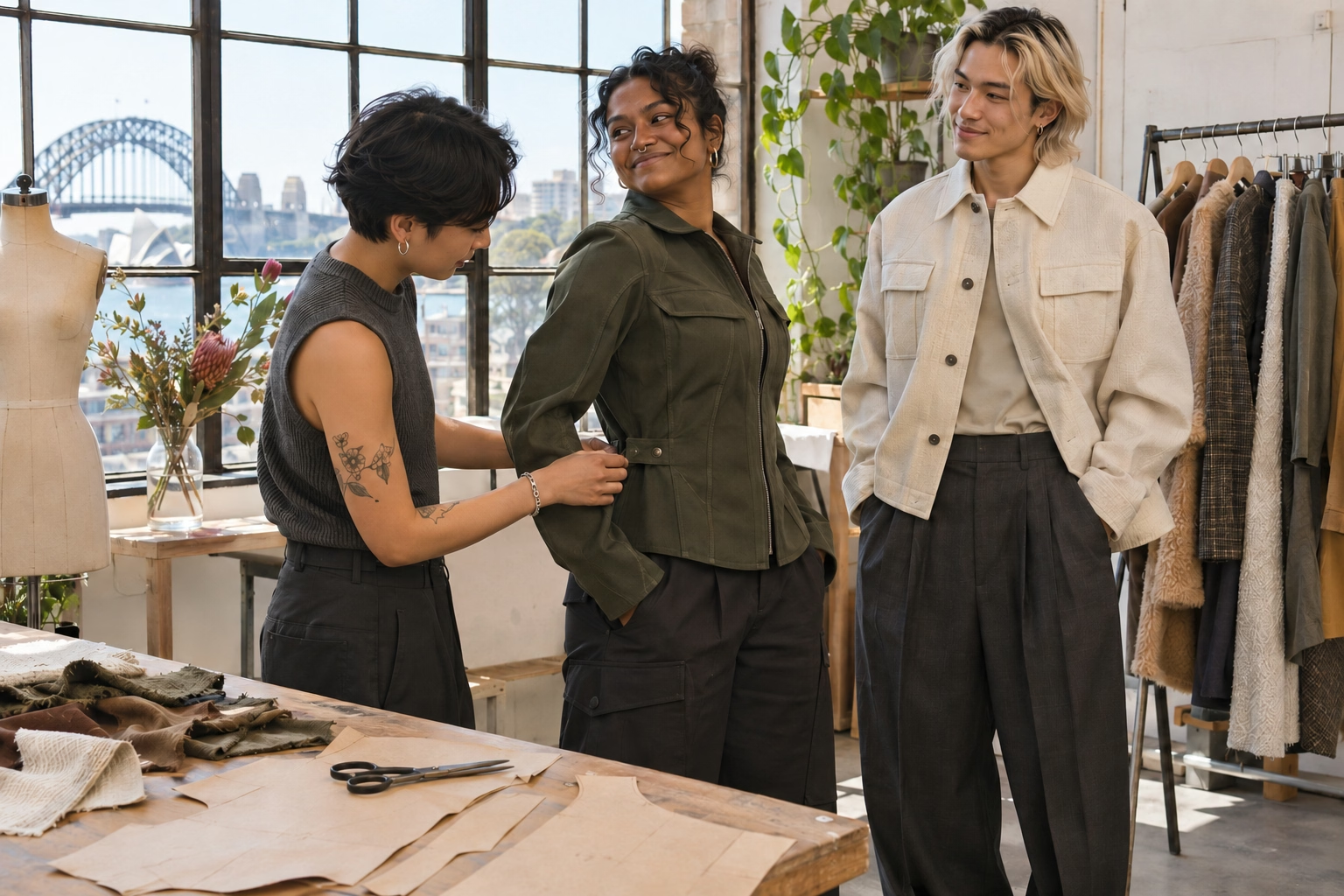
Gender-neutral apparel has moved from a niche proposition to a visible retail strategy across Australia’s urban fashion centres. This is not simply a matter of slapping a “unisex” label on a t-shirt. The shift demands that designers reconsider the very geometry of garments. Shoulder-to-hip ratios, sleeve pitches, and rise depths have historically been calibrated to either a male or female fit model. A genuinely gender-fluid approach requires drafting patterns that accommodate a wider range of body shapes without defaulting to a loose, shapeless silhouette as the only solution.
Sydney-based label Nuu Sew, founded by creative director Jayd, exemplifies this ethos at the independent level. Operating as a slow-fashion brand inspired by Japanese streetwear and subculture, Nuu Sew’s designs are explicitly built around the principle that clothing has no gender. Jayd’s work draws from op-shop and deadstock materials, creating one-of-a-kind pieces that challenge the assumption that gender-fluid fashion must be either minimalist or aggressively avant-garde. The brand’s growth from an Instagram sewing project to a viable business reflects a broader appetite among Australian consumers for authenticity over scale.
The Data Behind the Demand
The commercial logic is becoming harder to ignore. A 2026 study published in the Journal of Fashion Marketing and Management surveyed 400 Gen Z and millennial consumers in Sydney and Melbourne, examining purchasing behaviour around modular gender-neutral apparel—garments marketed independently of binary categories and featuring adaptable or reconfigurable elements. The research found that the relationship between self-focused personality traits and purchase intent was partially mediated by a need for uniqueness, and that this effect strengthened when consumers believed their purchase could help challenge traditional gender norms.
What this suggests is that gender-fluid fashion is not merely a product category. It is a form of consumer expression that carries perceived social weight. For Australian brands, the implication is clear: communications that link self-expression to credible impact cues will resonate more deeply than campaigns that treat gender neutrality as a purely aesthetic choice.
The Manufacturing Challenge
The practical obstacles remain substantial. Australia imports roughly 97 per cent of the clothing sold domestically, according to Australian Fashion Council research. This reliance on offshore production means that pattern-making innovations developed by local designers must be communicated clearly to manufacturers accustomed to binary sizing conventions. A gender-fluid collection that is poorly translated into production specifications risks arriving in stores as little more than oversized basics—a outcome that satisfies neither designers nor consumers.
Despite these challenges, the direction of travel is unmistakable. The Australian fashion industry, valued at approximately $27 billion, is being reshaped by consumers who are buying less but expecting more: more transparency, more durability, and more flexibility from the garments they choose to live in. Gender-fluid design, at its most rigorous, answers all three demands simultaneously.