
A Market Moving at Double-Digit Speed
Australia’s recommerce sector is no longer a niche corner of retail. The country’s recommerce market is forecast to expand by 11.3 per cent year on year in 2026, reaching US$4.68 billion, following a 13.7 per cent compound annual growth rate between 2021 and 2025. Fashion sits at the centre of that surge. According to Australia Post’s 2026 eCommerce Report, 46 per cent of Australians now buy second-hand items annually, and industry forecasts cited in the report project the local recommerce market will hit US$6.75 billion by 2029.
The momentum is visible in consumer behaviour. Roughly 72 per cent of Australians purchased pre-loved items in the past year, and the second-hand apparel segment is expanding at a striking 22.8 per cent compound annual growth rate. eBay estimates that Australian households are sitting on approximately AU$32 billion in potential resale value, with the average home holding around 15 sellable items.
The Platform Land Grab
The competitive intensity escalated sharply in 2026. European marketplace Vinted launched in Australia on 1 July with no selling fees and temporarily discounted shipping, partnering with Australia Post as its exclusive delivery provider. Vinted’s arrival followed Depop’s repositioning under eBay ownership, with Depop identifying Australia as one of its fastest-growing markets globally.
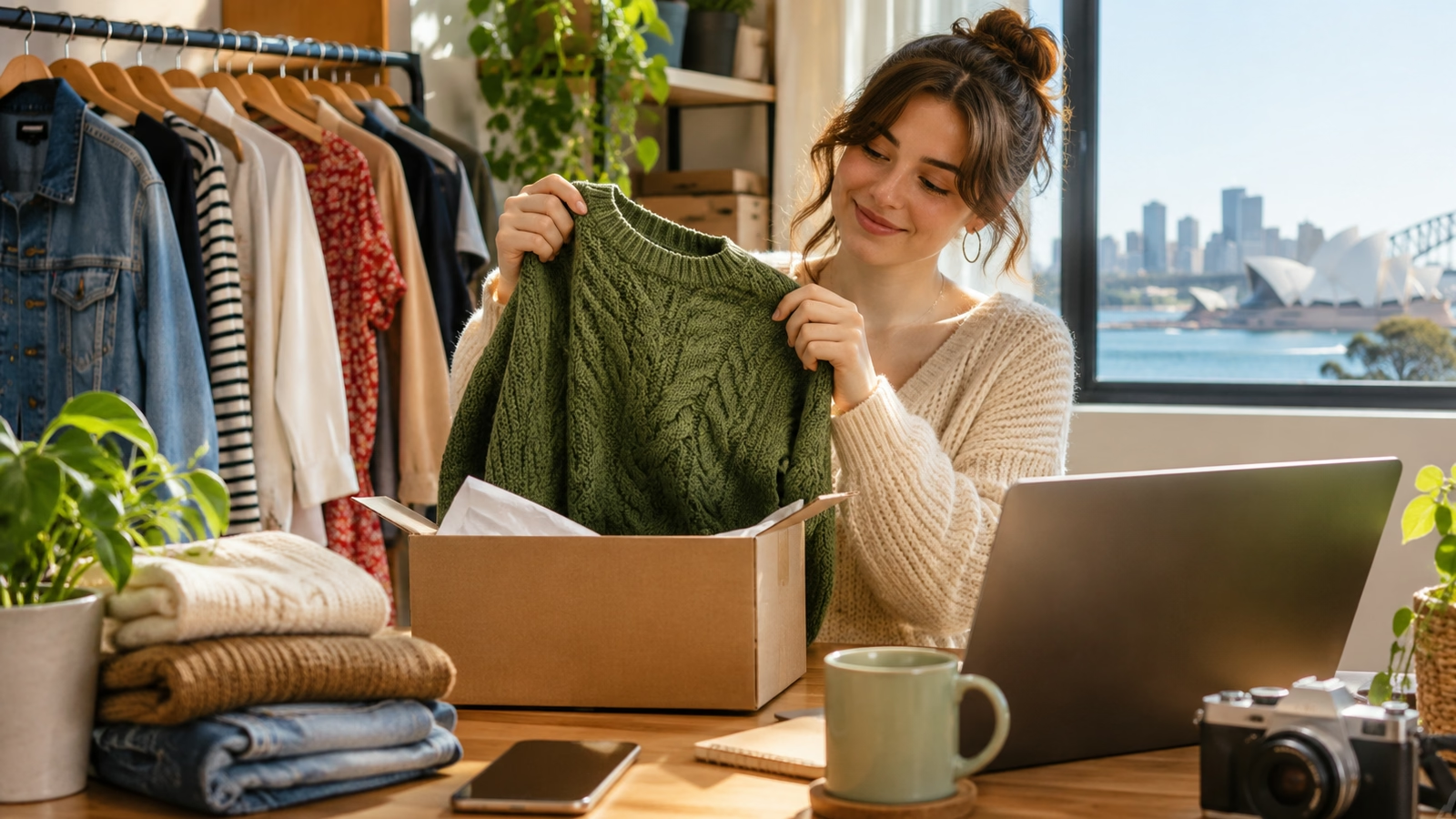
For shoppers like Jess Gilliland, who estimates she has bought about 200 pre-loved items across eBay, Depop and Vinted over six years, the appeal is practical as much as ethical. “The benefit is obviously circular fashion,” she told the ABC. But she also flags the paradox: resale apps can encourage overconsumption even while extending garment life.
What the Resale Boom Does — and Doesn’t — Solve
Resale keeps garments in circulation and reduces demand for new production, but it is not a complete circular system. Items that cannot be resold still require repair, remanufacturing or fibre-to-fibre recycling. The resale wave is therefore best understood as the entry point of a much broader circular transition — one that increasingly depends on brands taking responsibility for what happens after the point of sale.