
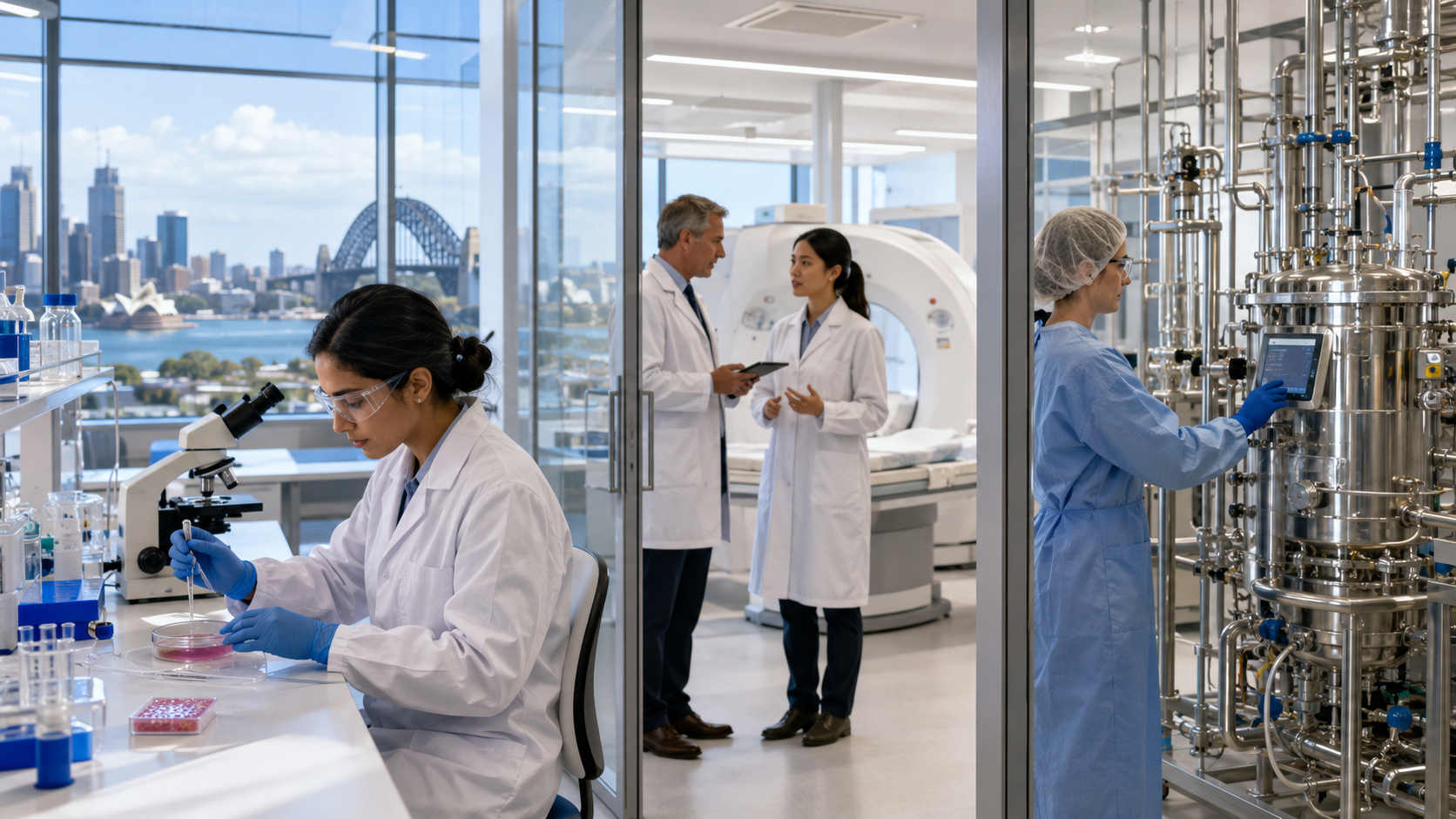
The global pandemic exposed weaknesses in international medical supply chains and changed how governments evaluate biotechnology. For Australia, access to vaccines, diagnostic materials, active pharmaceutical ingredients, and specialised manufacturing equipment became a matter of national resilience rather than ordinary procurement.
This experience accelerated efforts to strengthen domestic biomanufacturing. Australia is now seeking to connect its strong medical research base with the infrastructure required to manufacture vaccines, biologic medicines, RNA products, and other advanced therapies at commercial scale.
From Research Capability to Production Capacity
Australia has long produced world-class biomedical science, but large-scale manufacturing has remained more limited. Developing a vaccine or biologic medicine involves far more than identifying a promising scientific mechanism.
Companies need production facilities that meet strict Good Manufacturing Practice standards, validated quality systems, specialised staff, reliable suppliers, and regulatory approval. Small differences in temperature, raw materials, purification methods, or storage conditions can affect product safety and consistency.
This is why the transition from a university laboratory to a commercial manufacturing plant is often described as biotechnology’s “valley of death.” A scientifically promising product may fail to progress if the company cannot finance clinical-grade production.
MTPConnect, Australia’s life sciences innovation organisation, provides information about programs supporting medical technology, biotechnology, pharmaceuticals, and commercial translation:
RNA Technology Becomes a Strategic Field
Messenger RNA vaccines demonstrated the potential of programmable biological platforms. Once researchers identify an appropriate genetic sequence, RNA technology can potentially be adapted for different infectious diseases and therapeutic applications.
Australian universities and research institutes are investigating RNA vaccines, cancer immunotherapies, delivery systems, and manufacturing methods. The challenge is to build an ecosystem that covers the entire development process, including sequence design, lipid or alternative delivery technologies, formulation, quality testing, clinical trials, and cold-chain logistics.
Australia’s interest in RNA should not be viewed only through the lens of pandemic preparedness. The technology may support future treatments for cancer, rare diseases, and other conditions where cells need temporary biological instructions.
Real-World Innovation in Vaccine Delivery
Australian companies are also exploring alternatives to conventional needles. Brisbane-based biotechnology company Vaxxas, for example, has developed a high-density microarray patch designed to deliver vaccine material through microscopic projections applied to the skin.
Patch-based delivery could potentially simplify administration and reduce some logistical barriers, although products still need to meet clinical, regulatory, manufacturing, and cost requirements. Such platforms demonstrate how Australian biotechnology can compete through specialised innovation rather than attempting to reproduce every part of the global pharmaceutical industry.
Manufacturing Creates Wider Economic Benefits
Biomanufacturing can generate employment for process engineers, quality-control scientists, regulatory specialists, technicians, supply-chain managers, and laboratory professionals. It may also support related industries that produce sterile components, packaging, sensors, laboratory instruments, and cold-storage systems.
However, manufacturing facilities require consistent demand. A plant built for emergency production may become economically difficult to maintain when demand declines. Governments and companies therefore need flexible facilities capable of producing multiple products.
The Strategic Test for Australia
Australia must determine which biotechnology capabilities are essential to retain domestically and which can remain part of diversified international supply chains. Complete self-sufficiency would be unrealistic and expensive, but excessive dependence on a small number of overseas suppliers creates health-security risks.
A balanced strategy would prioritise flexible manufacturing, trusted international partnerships, skilled workforce development, and support for products with genuine commercial demand. By combining scientific excellence with scalable production, Australia can improve emergency preparedness while establishing a more resilient and export-oriented biotechnology sector.