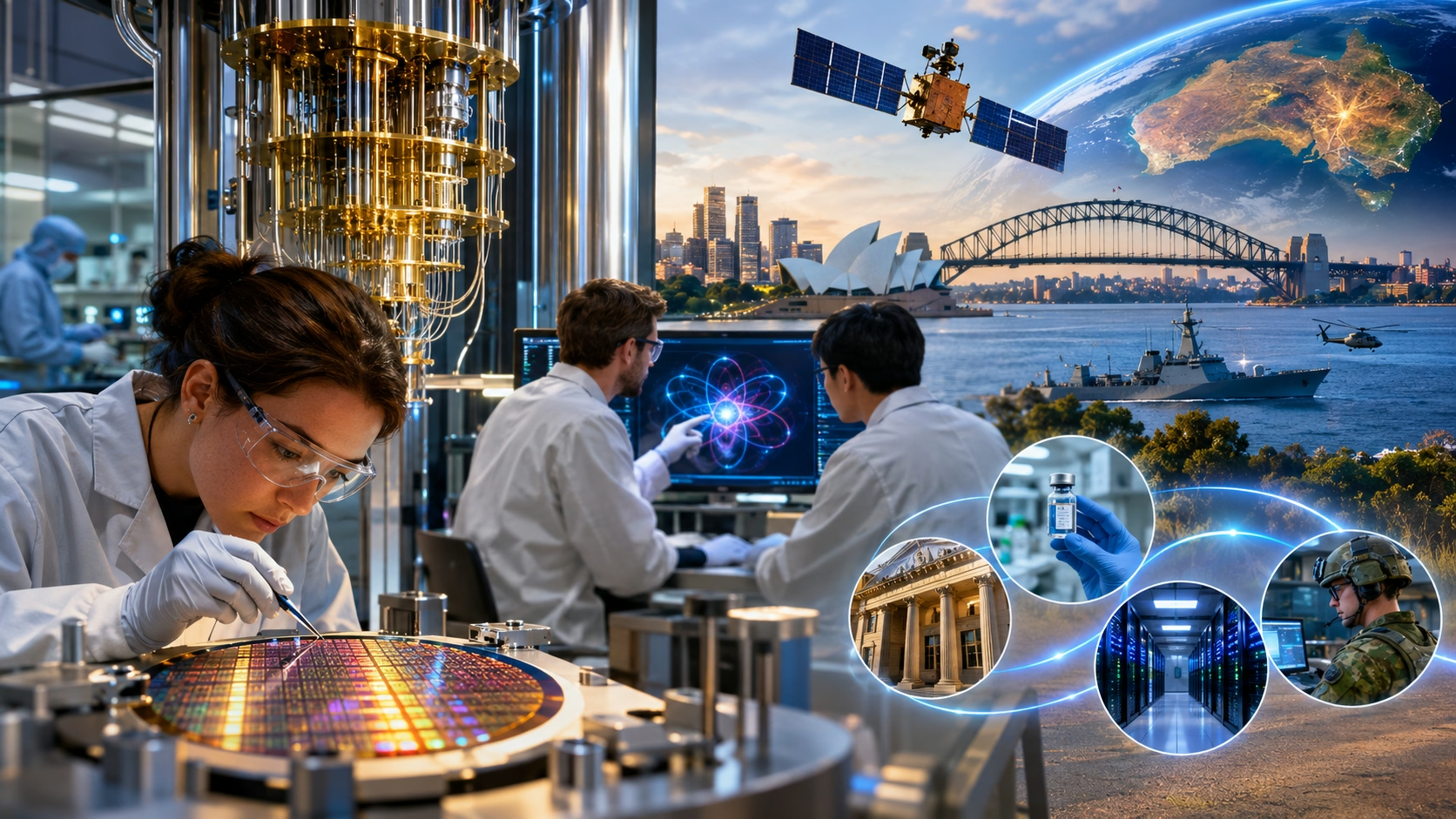

Australia’s quantum technology sector has crossed a threshold that few middle powers ever reach. In 2026, the question is no longer whether Australian quantum startups can compete globally—it is whether they can convert scientific leadership into sovereign industrial capability before the window closes.
The Silicon Bet That Sets Australia Apart
Sydney-based Diraq is the clearest expression of this shift. Spun out of UNSW in 2022, the company is developing utility-scale quantum computers using silicon-based qubits built on a CMOS-compatible architecture. That engineering choice matters: it allows Diraq to leverage existing semiconductor fabrication lines rather than building exotic new infrastructure from scratch, driving down cost and size while scaling toward millions of qubits by 2031.
In February 2026, the National Reconstruction Fund Corporation (NRFC) took a $20 million equity stake in Diraq, citing the company’s potential to lead the world in quantum computing. The validation is not merely financial. Diraq is one of only 11 companies globally to reach Stage B of DARPA’s Quantum Benchmarking Initiative—a filter that has also advanced Google, IBM, and Oxford Ionics. In October 2026, DARPA confirmed Diraq would move to the final viability stage, placing an Australian spinout in the same evaluation tier as the world’s most capitalised quantum programmes.
Manufacturing Precision as Strategic Leverage
If Diraq represents scale through silicon, Silicon Quantum Computing (SQC) represents precision as power. Founded in 2017 by Professor Michelle Simmons at UNSW, SQC is the only company in the world manufacturing quantum chips with atomic (0.13-nanometre) precision while already selling quantum-enhanced AI products to enterprises and governments.
The NRFC initially invested $20 million in SQC, then added a further **$40 million in June 2026**, trebling its stake. The capital is expanding SQC’s proprietary PAQMan™ atomic manufacturing process—the most precise semiconductor manufacturing technology in the world—and anchoring a globally competitive quantum chip supply chain on Australian soil. London-based quantum specialist Firgun Ventures made SQC its first Australian investment the same month, signalling that offshore capital now views Australian quantum manufacturing as a distinct asset class rather than a research curiosity.
The strategic logic is difficult to ignore. The National Quantum Strategy estimates Australia’s quantum industry could be worth $6 billion and employ 19,400 people by 2045. But the deeper value lies in sovereignty: quantum computers capable of transforming banking, defence, pharmaceuticals, and AI cannot be safely rented from geopolitical rivals.
Timing, Defence, and the AUKUS Signal
Adelaide-based QuantX Labs illustrates how quantum timing technology feeds directly into national security. In June 2026, the company secured **US$5 million in seed funding** from Serendipity Capital, with plans to create more than 50 highly skilled jobs and up to $120 million in new revenue over four years. QuantX is commercialising optical atomic clock technology for defence and critical infrastructure, and has already launched a critical component of its clock into orbit.
Serendipity Capital’s founder, Rob Jesudason, framed the investment in explicitly strategic terms: modern defence systems, telecommunications networks, and critical infrastructure all depend on precise timing, and that dependency is growing as systems become more complex. QuantX’s growth reinforces South Australia’s position in capabilities aligned with AUKUS Pillar II, the advanced-technology pillar of the trilateral pact.
The Sovereign Capital Stack
What distinguishes the 2026 Australian quantum story is not a single breakthrough but the emergence of a coherent sovereign capital stack. The NRFC—a $15 billion sovereign investor in manufacturing capability—is deploying equity across Diraq, SQC, and adjacent enabling technologies. Private capital is co-investing rather than waiting on the sidelines. DARPA is providing independent technical validation that no domestic agency could credibly replicate.
The unresolved question is commercial, not scientific. Diraq targets its first product—a machine capable of genuine quantum advantage—by 2029. SQC already has commercial products in market, including a quantum machine learning system that Telstra credits with a dramatic reduction in model training time. Whether these companies can convert early technical advantage into durable market position before larger, better-funded rivals scale is the defining test of Australia’s quantum sovereignty experiment.