
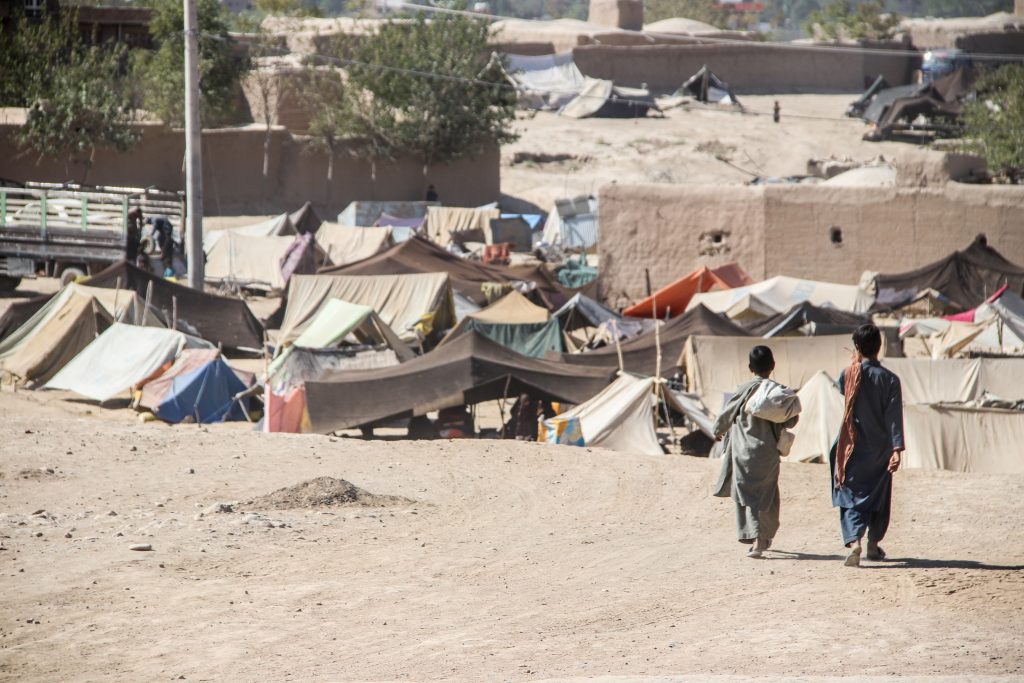
A simple self-help workbook paired with brief phone support can make a measurable difference to the mental health of displaced refugees, a new study has found.
In Indonesia, where UNSW researchers tested the intervention, approximately 12,000 refugees live in a state of waiting – sometimes for years – unable to work, separated from family and with no clear pathway to resettlement.
“It’s a very, very difficult context,” says the study’s lead author, Professor Angela Nickerson, a clinical psychologist and Director of the Refugee Trauma and Recovery Program at UNSW Sydney.
“People are often living in prolonged limbo, without stable rights, work or support, sometimes for over a decade,” Prof. Nickerson says.
She says this creates a critical gap between the significant mental health burden held by refugees and the resources available to promote their psychological recovery.
To address this gap, the research team – from UNSW Sydney, the University of Newcastle and the University of Melbourne – partnered with Indonesian and regional organisations, including the refugee-led Refugee Learning Nest, Indonesian legal aid organisation SUAKA, Universitas Gadjah Mada and HOST International.
Together, they adapted and delivered the intervention within refugee communities in Indonesia.
“Working closely with refugee communities and local partner organisations was central to the project,” Prof. Nickerson says.
“Their experience and understanding of the local context helped ensure the program was responsive to community needs.”
Beyond the system
The study reports that in 2024, one out of every 67 people in the world was forcibly displaced. More than three-quarters landed in lower- and middle-income countries, where access to formal mental health care is limited.
The exposure to persecution and war means refugees and asylum seekers face a high burden of mental illness. The estimated rate is 31.5% for both post-traumatic stress disorder (PTSD) and depression.
“For these refugees, resources are scarce and living conditions can be precarious,” Prof. Nickerson says.
“Their lack of legal status limits their access to financial support, housing and essential services,” she says.
“This increases their vulnerability to discrimination, violence and exploitation.”
She says the intervention might be not only feasible but also effective in settings where there aren’t a lot of resources.
The measurable impact
The study evaluated an existing World Health Organization program, by working with 303 Farsi-speaking Afghan refugees living in Indonesia. The program, Doing What Matters in Times of Stress, is a guided self-help intervention designed for low-resource settings.
While the intervention itself is not new, this was the first fully powered trial to test it as a standalone program.
The researchers say the humanitarian crisis in Afghanistan is one of the “most complex crises of our time”. Many Afghan refugees are exposed to prolonged pre-migratory trauma, as well as perilous migration journeys. The violence, loss and extended periods of insecurity experienced in transit or displacement can compound psychological distress in new host countries.
The participants received an illustrated workbook in their own language, alongside five short calls from facilitators. The facilitators were members of the refugee community themselves, trained and supported through collaborations with Refugee Learning Nest, SUAKA and local partner organisations to guide others through the material.
“This not only overcomes some of the difficulties with resources, but it also builds capacity within refugee communities,” says Dr Philippa Specker, a UNSW researcher and clinical psychologist who led the training.
“It was inspiring to work with the wonderful team of assessors and facilitators, as well as Refugee Learning Nest and SUAKA, to better understand what displaced refugee communities are experiencing,” Dr Specker says.
In the randomised control trial, those who took part in the program showed significantly greater mental health improvements than those in the control group who had not yet received the program.
“We were really excited to see that such a brief, light-touch kind of an intervention could have a meaningful impact,” says Dr Specker.
Compared to the control group, participants reported a greater reduction in psychological distress and post-traumatic stress symptoms, alongside improvements in wellbeing, social functioning and daily life.
“It was effective in reducing psychological distress and PTSD symptoms, as well as improving wellbeing and overall daily functioning, for refugees living in a transit country.”
By a one-month follow-up, around half of those in the intervention group showed meaningful improvement or recovery, compared with about 30% in the control group.
Keeping it simple
The therapy approach draws on acceptance and commitment therapy – helping people manage thoughts and emotions in stressful situations they cannot change.
Prof. Nickerson says the therapy equips patients with the skills and tools to be able to manage the cognitive and emotional avoidance that can exacerbate mental health difficulties.
“In these kinds of settings, more traditional problem-solving approaches might not be as effective because we don’t know if the problems are immediately solvable,” Prof. Nickerson says.
The program teaches strategies such as mindfulness, acceptance and value-driven action – tools designed to be used even in the most constrained circumstances.
That focus may be particularly important in transit countries like Indonesia, where refugees often lack basic rights, including access to work, healthcare and education.
The power of connection
One surprise finding was that the control group – who had not yet received the intervention – also showed some improvement across the course of the trial.
The researchers suggest regular contact with trained assessors, who practised empathic listening, may have played a role.
“This highlights the potential importance of connection and emotional support in fostering refugees’ wellbeing,” the study says.
The research team is now working with Indonesian and regional partners to share the findings with community organisations, service providers and policymakers – with the aim of supporting broader implementation of low-cost mental health programs for displaced communities.
“With the largest amount of forcible displacement we’ve ever seen worldwide, having low-cost interventions that can be delivered by peers is a really important step forward,” Prof. Nickerson says.
Professor Angela Nickerson was recently awarded a grant to improve refugee wellbeing in Australia through the same intervention. The outcomes of the project will inform how settlement services can better support refugees.
This press release has also been published on VRITIMES